We have held a number of events this year including:
- 2 x water training days with Chris Guest
- Breed Celebration Lunch at the Kennel Club
- Introduction to the breed virtual seminar
- Have a go mantrailing – Cannock Chase, South Wales and Cheshire
- First aid workshops
- Health seminars – HUU, genetics, health testing
- Munsterfest
- Discover your pets potential with Sharon Pinkerton
- Shotover training day with Paul Nixon
- Introduction to deer tracking with Alex Hatton
- Pre-Crufts handling workshop with Nicole Coe
- Two-day working test training in South Wales
Discover your pets potential with Sharon Pinkerton (September 2024) – Ceri Simpson
Held at Rickney’s training ground the LMA hosted a specialised training session with renowned dog trainer Sharon Pinkerton, known for her expertise in working with versatile hunting breeds.
The training day focused on developing core skills for both handlers and dogs, emphasising obedience and fieldwork tailored to the unique abilities of HPR breeds (and during this session we even had a ‘honorary HPR’ in the form of a field spaniel)
Sharon Pinkerton provided hands-on guidance, offering personalised feedback and advanced techniques to help participants refine their training approach.
All dogs and handlers showed notable progress throughout the day, benefiting from the structured activities and Sharon’s insightful instruction. The event fostered a spirit of learning and community among attendees, reinforcing the importance of breed-specific training and ongoing education. The day concluded with an informal Q&A session, giving participants the opportunity to engage directly with Sharon and share their own training experiences.

Introduction to deer tracking (February 2024) – Stephanie Phillips
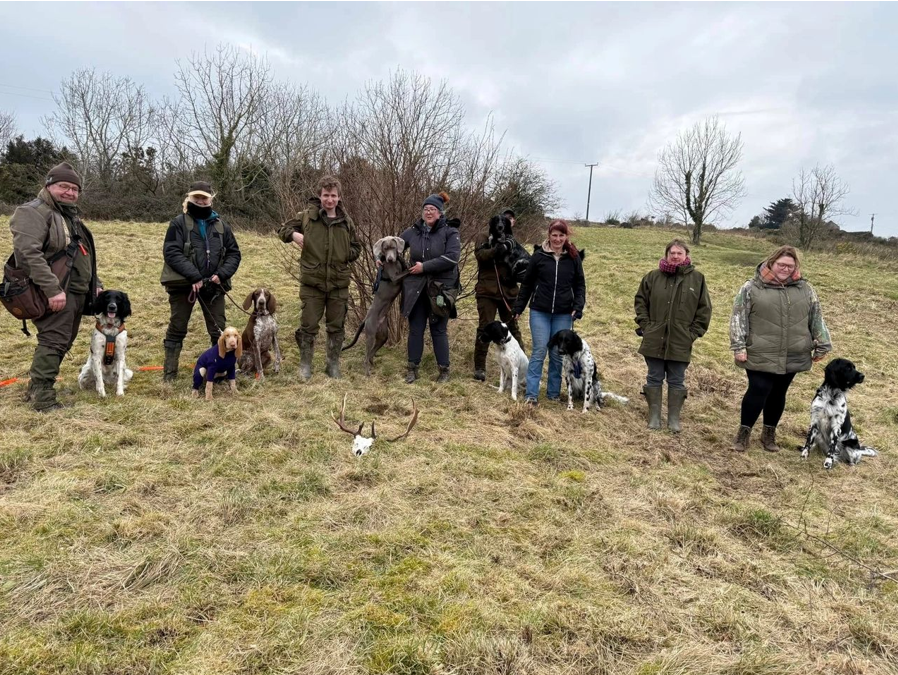
Alex is a registered tracker for the United Kingdom Deer Track and Recovery (UKDTR) with his own Large Munsterlander, Georgie. Stephanie Phillips represented the LMA attending with her two Large Munsterlanders. To enable everyone to fully participate in the day the numbers were limited to 8 places and the event was sold out. There was a mix of breeds, Large Munsterlanders, Bracco Italiano, Cocker Spaniel and a Slovak.
Alex explained the reasons behind deer tracking, why it was required and the importance in locating wounded deer. He outlined how the tracks would be laid for the day. Each dog would be given a blood track to follow which would culminate in a “find” which, for the training day, would be the hoof of a deer. The individual tracks were laid earlier that morning using blood from a deer which was walked around using special shoes which deposited the blood on the ground.
The dogs were introduced to the “shot site” where there was lots of scent and blood for them to pick up the trail. The dogs wore a harness and long line and, after being given time to sniff around the area to pick up the scent, went off to track the wounded deer. Each trail was prepared with difficulties such as loops, turns, rough ground, etc. Due to the location which was open to the public, the scent could be mixed in or crossed with the public and their pet dogs.

Each dog worked individually and it became apparent that each had their own way of tracking. Some worked quickly whilst others took their time and steadily worked out where the track was going.
Alex explained what to do and what to look out for when working the dog. He provided feedback and guidance on what the dog was doing and how to read the signals the dog was giving during the tracking as the dog was working. Those who were not tracking followed behind, at a reasonable distance, to observe what was happening. All the dogs successfully completed their tracks and found their lost deer.
At the end of the session, when all dogs had finished, Alex introduced us all to “baying”. This is when the dog tracks the wounded deer and finds it. If it is still alive the dog has to alert their handler but must not approach the deer as this could result in injury to the dog should the deer/stag lunge at the dog. The dog must not approach or attempt to bite the deer. Alex illustrated this using his own Large Munsterlander, Georgie, and the skeletal head and antlers of a deer. Georgie showed how the dog would approach the head if it was still and on the ground, but as soon as it moved or lunged towards her she would back off and bark and once the head was on the ground and not moving she would approach again. All the dogs had a chance to practice this and all the dogs thoroughly enjoyed it.